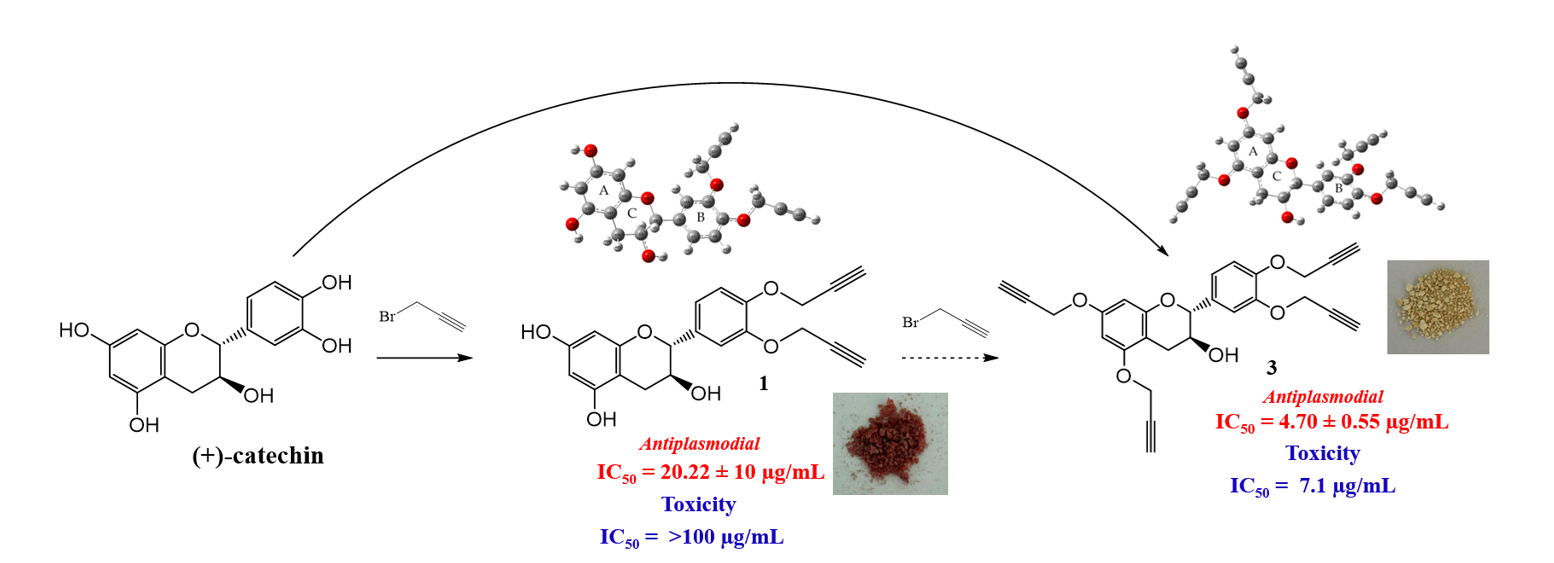
In this study, novel di- and tetrapropargyl derivatives of (+)-catechin were synthesized and characterized using IR, 1H and 13C{1H} NMR, as well as LC-MS. Furthermore, the ground-state geometries of compounds 1 and 3 were optimized using DFT calculations at the B3LYP/6-31G(d) level. These optimizations allowed the identification of key bond length and angle variations. Tetrapropargyl-catechin (3) shows a significantly higher antiplasmodial activity than dipropagyl-catechin (1), with IC50 values of 4.70 µg/mL and 20.22 µg/mL, respectively. Notably, 1 demonstrated low toxicity (IC50 > 100 µg/mL), while 3 showed higher toxicity (IC50 = 7.1 µg/mL). Complementary in silico molecular docking studies were conducted using the PfAMA1 protein (PDB: 3SRJ), a crucial receptor involved in parasite-host cell interaction. Both compounds demonstrated favorable binding profiles, with 3 achieving the best docking score (E = −7.4 kcal/mol), in agreement with the in vitro results. Computational analyses, including HOMO–LUMO and molecular electrostatic-potential mapping (MEP), revealed insights into the compounds' electronic properties and potential for further functionalization. The introduction of multiple propargylic groups in 3 enhanced π-delocalization, thus potentially increasing its binding affinity, while it may also be associated with higher cytotoxicity. These findings highlight the promising antimalarial potential of propargylated catechin derivatives, particularly dipropargyl-catechin (1), for the favorable cytotoxicity profile, for future antimalarial drug development.
Figures et illustrations