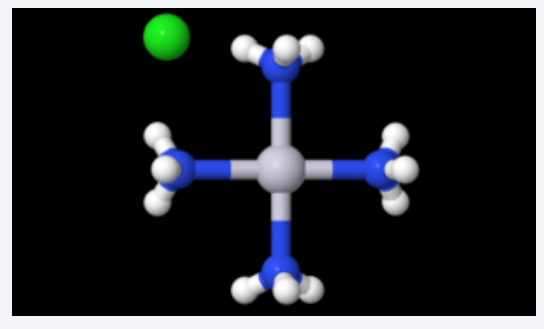
The title compound [Pt(NH3)4]Cl2 (1), prepared by reaction of (NH4)2[PtCl4] with an excess of NH3 in aqueous solution, was crystallized from water and its structure redetermined by single-crystal X-ray diffraction at four different temperatures in the range from 273 K down to 100 K. 1 is composed of square-planar [Pt(NH3)4]2+ complex cations and Cl- anions and crystallizes in the tetragonal crystal system. Remarkably, the solid state structure is porous (approx. 18% of the crystal volume is void space) and features one-dimensional open channels of a diameter of ∼3–4 Å. Unexpectedly, these channels are free of solvent molecules, although the crystals were obtained from aqueous solutions. N-H⋯Cl hydrogen bonding interactions between the square-planar [Pt(NH3)4]2+ dications and the Cl- counter ions result in a three-dimensional hydrogen bonding network that stabilizes the porous solid state structure. The hydrogen atoms of the ammonia ligands and their corresponding N-H⋯Cl hydrogen bonds are localized at low temperature (space group I4/mmm) but disorder dynamically above 173 K (space group P4/mmm). The order-disorder transition is accompanied by significant changes in the Pt–Pt stacking distances and a fourfold reduction of the unit cell volume.
Retour aux recherches
Recherche
•
Redetermination of the crystal structure of tetrammineplatinum(II) dichloride – A microporous hydrogen-bonded 3D network exhibiting a temperature-dependent order-disorder phase transition
L. Brieger, S. Henke, A. Said Mohamed, I. Jourdain, M. Knorr, C. Strohmann; « Redetermination of the crystal structure of tetrammineplatinum(II) dichloride – A microporous hydrogen-bonded 3D network exhibiting a temperature-dependent order-disorder phase transition »; Inorganica Chimica Acta, (2019), 495, 119002. https://doi.org/10.1016/j.ica.2019.119002.