Retour aux recherches
Recherche

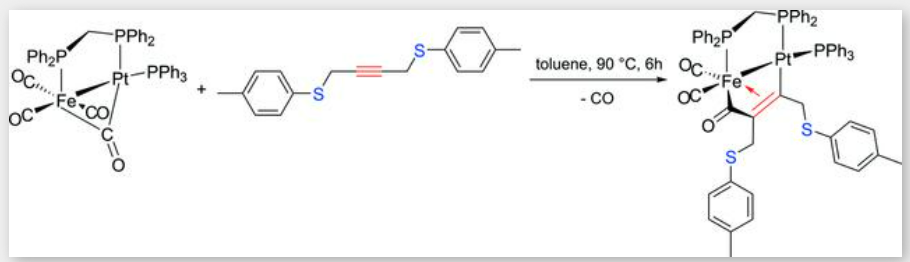
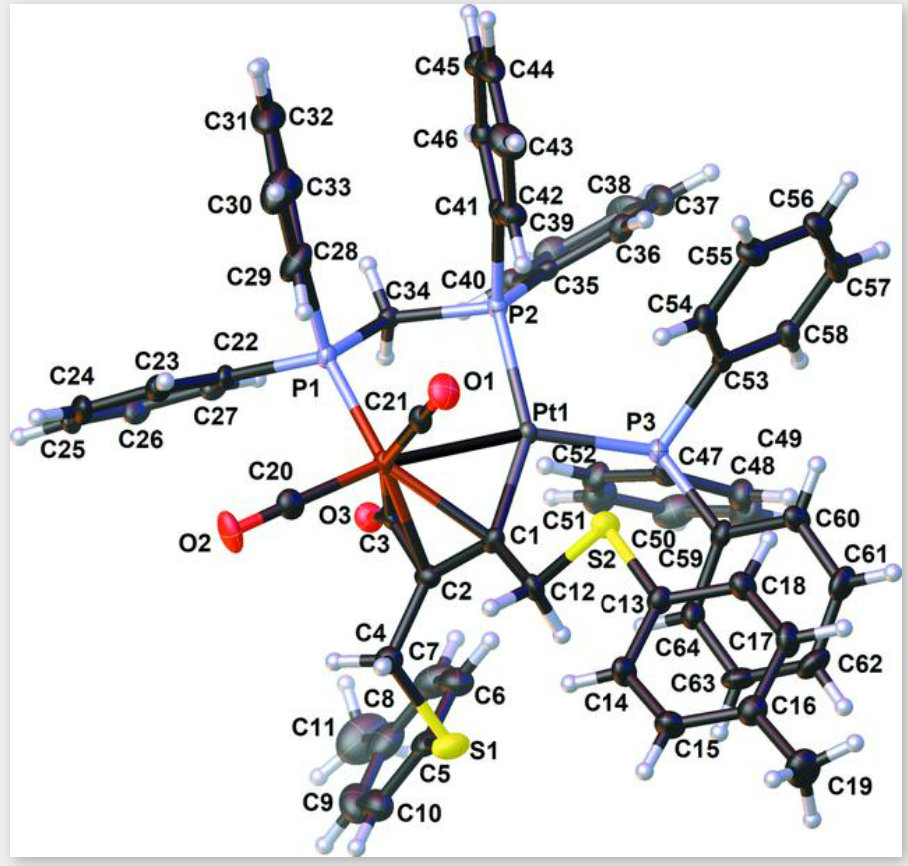
Crystal structure of {μ2-1,2-bis[(4-methylphenylsulfanyl]-3-oxoprop-1-ene-1,3-diyl-1:2κ2C3:C1}dicarbonyl-1κ2C-[μ2-methylenebis(diphenylphosphane)-1:2κ2 P:P′](triphenylphosphane-2κ P) iron-platinum (Fe-Pt), [(OC)2Fe(μ-dppm){μ-C(=O)C(4-MeC6H4SCH2)=CCH2SC6H4Me-4}Pt(PPh3)]

A. Said Mohamed, Isabelle Jourdain, Michael Knorr, Lukas Brieger and Carsten Strohmann ; « Crystal structure of {μ2-1,2-bis[(4-methylphenylsulfanyl]-3-oxoprop-1-ene-1,3-diyl-1:2κ2C3:C1}dicarbonyl-1κ2C-[μ2-methylenebis(diphenylphosphane)-1:2κ2 P:P′](triphenylphosphane-2κ P) iron-platinum (Fe-Pt), [(OC)2Fe(μ-dppm){μ-C(=O)C(4-MeC6H4SCH2)=CCH2SC6H4Me-4}Pt(PPh3)] » ; Acta Cryst. (2020). E76, 1087–1091. https://doi.org/10.1107/S2056989020007859.

The title compound represents the first example of a diphosphane-bridged heterobimetallic Fe—Pt dimetalla­cyclo­pentenone complex resulting from a bimetallic activation of metal-coordinated carbonyl ligand with an inter­nal alkyne, namely 1,4-bis­(p-tolyl­thio)­but-2-yne. The bridging μ2-C(= O)C(CH2SC6H4Me-4)=CCH2SC6H4Me-4 unit (stemming from a carbon–carbon coupling reaction between CO and the triple bond of the alkyne di­thio­ether) forms a five-membered dimetalla­cyclo­pentenone ring, in which the C=C bond is π-coordinated to the Fe center.

Figures et illustrations